
Partners In Every Sense: A Clear Path Forward
Relationship Therapy
with Angela Sloan, LCSW
Reduce the cycle of shutdowns, defensiveness, emotional punishment, rebuild attraction, and share the mental load in 90 days.

Partners In Every Sense: A Clear Path Forward

Relationship Therapy
with Angela Sloan, LCSW
You Are Tired From Carrying This Pattern, Alone.
You love your partner. That has never been the question.
What’s breaking you is the pattern.
The same fight about chores; the same shutdown when you try to talk.
The same feeling that you are either too much or not enough.
This program helps you name it clearly, repair it honestly, and rebuild something that feels like partnership instead of survival.
You Are Tired From Carrying This Pattern, Alone.
You love your partner. That has never been the question.
What’s breaking you is the pattern.
The same fight about chores; the same shutdown when you try to talk.
The same feeling that you are either too much or not enough.
This program helps you name it clearly, repair it honestly, and rebuild something that feels like partnership instead of survival.
Here’s how it works…
Partners In Every Sense is a structured 90 day pathway designed to help you stop surviving inside your relationship and start functioning like actual partners again.
This is not a “just communicate better” approach.
This is not about forcing positivity.
This is not about deciding whether to stay or go.
Each phase builds on the one before it so you are not skipping ahead, self abandoning, or making decisions from burnout, guilt, or fear.
You will not be told to “just accept it.”
You will not be told to “just try harder.”
You will learn how to interrupt the pattern that keeps both of you stuck.
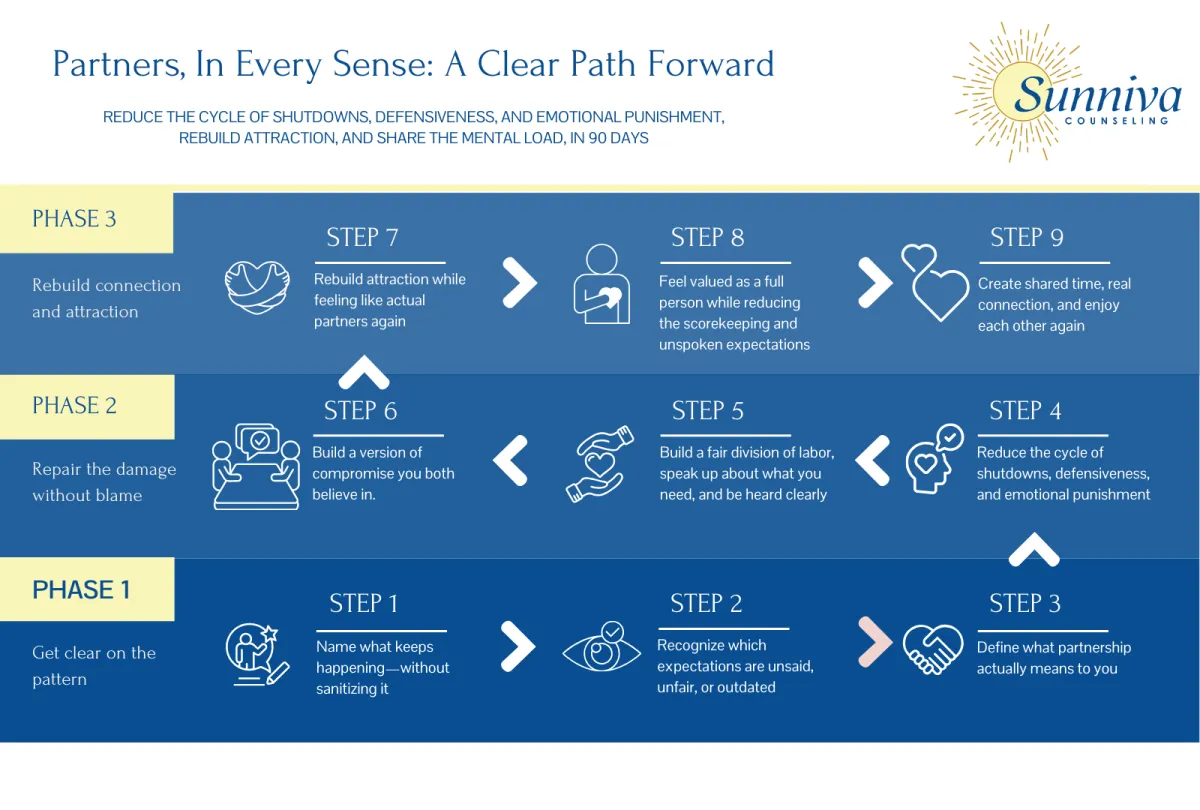
Phases of the Program
Phase 1: Get Clear On The Pattern
Before you fix anything, you have to see it clearly.
Most couples try to jump straight to solutions.
Phase 1 is about telling the truth about what keeps happening, without sanitizing it and without turning each other into villains.
STEP 1: Name what keeps happening—without sanitizing it
Start telling the truth about the fights that always end the same way.
The conversations that never go anywhere. The shutdowns. The defensiveness. The scorekeeping.
This isn’t about blame.
It’s about giving language to the loop you’ve been stuck in so you can stop questioning your own reality.

STEP 2: Recognize which expectations are unsaid, unfair, or outdated
Most resentment grows in the space of unspoken rules.
In this step, you begin noticing:
What was never agreed to. What you inherited from family models.
What you silently accepted.
What you’ve been tolerating because you didn’t want to “start something.”
You stop carrying invisible agreements that were never consciously chosen.
STEP 3: Define what partnership actually means to you
“Less fighting” is not a vision.
You clarify what you actually want:
Shared mental load. Emotional safety. Mutual desire without pressure.
Care that is reciprocal, not managerial.
A relationship where you feel like teammates, not adversaries.
This is where you begin reclaiming your needs without guilt. Instead of making decisions from burnout, fear, or self-doubt,
you start making them from self-trust.

Phase 2: Repair The Damage Without Blame
Once you can see the pattern clearly, the next step is interrupting it.
Phase 2 is where we stop repeating the same fight in slightly different wording and start changing the structure underneath it.
This is not about deciding who is right. It is not about reliving every argument.
This phase moves you from “we keep hurting each other” to “we know how to handle this differently."
STEP 4: Reduce the cycle of shutdowns, defensiveness, and emotional punishment
In this step, you learn how to interrupt the exact moment where things usually spiral.
You build skills that help you:
Stay regulated during conflict
Say what you mean without escalation
Hear impact without collapsing or counterattacking
Stop using withdrawal, criticism, or intimacy as leverage
Repair quickly instead of pretending nothing happened
The goal is emotional safety that does not depend on one person staying quiet.


STEP 5: Build a fair division of labor, speak up about what you need, and be heard clearly
Resentment does not disappear with better tone.
It disappears with shared responsibility.
You will:
Map what is actually being carried
Clarify ownership instead of vague promises
Speak needs without being painted as controlling
Create systems that reduce reminders and nagging
Protect both partners’ rest and energy
This is where you stop feeling like a manager, maid, or emotional coordinator and start feeling like a partner.
STEP 6: Build a version of compromise you both believe in
Compromise often turns into martyrdom or silent resentment.
Instead, you learn how to:
Hold your experience without attacking theirs
Negotiate without scorekeeping
Set boundaries without emotional punishment
Make agreements that account for capacity, not fantasy
Build solutions that both of you can sustain
No one disappears. No one dominates. No one carries it alone.

Phase 3: Rebuild Connection and Attraction
Once the pattern is clear and the structure is more stable, you stop living in defense mode.
Phase 3 is not about “trying harder” at romance.
It is about rebuilding connection from safety, fairness, and mutual respect.
Attraction does not return because you schedule more sex.
It returns when resentment decreases.
It returns when you feel like teammates.
It returns when neither of you is managing the other.
This phase helps you move from survival partnership to chosen partnership.
STEP 7: Rebuild attraction while feeling like actual partners again
Attraction fades when you feel like a parent, a project manager, or an adversary.
It grows when you feel respected, supported, and emotionally safe.
In this step, you will:
Reduce the resentment that has been quietly killing desire
Stop using sex as reassurance, leverage, or proof of love
Rebuild emotional safety so physical intimacy feels voluntary
Shift from “roommates managing logistics” to “partners choosing each other”
Restore curiosity instead of criticism
This is where connection begins to feel natural again instead of forced.


STEP 8: Feel valued as a full person while reducing scorekeeping and unspoken expectations
Many couples are stuck in invisible scoreboards.
Who initiated. Who declined. Who did more.
Who sacrificed more. Who is owed.
This step helps you:
End the cycle of conditional affection
Separate desire from obligation
Replace silent contracts with clear agreements
Feel seen beyond performance or productivity
Experience intimacy that is mutual, not managerial
STEP 9: Create shared time, real connection, and enjoy each other again
Repair is not the finish line. Living well together is.
In this step, you:
Reintroduce lightness without pretending the past didn’t happen
Protect shared time instead of defaulting to work, screens, or logistics
Build rituals that strengthen connection
Experience partnership that feels cooperative instead of tense
Enjoy each other without waiting for the next argument
This is where the relationship stops being a project.
It becomes something you actually want to live inside.

The Whole Path, In One Clear Arc
Phase 1 helps you see the pattern clearly.
Phase 2 helps you change how it functions.
Phase 3 helps you live inside it differently.
This is not about becoming perfect communicators. It is not about eliminating conflict. It is not about forcing attraction back.
Instead, you build something steadier.
A relationship where:
The mental load is visible and shared
Conflict does not feel like war
Intimacy is not conditional
Rest is protected for both of you
You feel like teammates again
This is not about saving face. It is about rebuilding partnership. And that changes everything.
A Note From Angela
I built this program from both professional experience and real life.
I have worked with couples navigating postpartum depression, high-conflict co-parenting, blended family stress, neurodivergence, and the quiet erosion that happens when one partner carries more than they can sustain. I have seen how quickly love gets buried under shutdown, resentment, invisible labor, and the pressure to just “handle it.”
Most relationships do not break because people do not care.
They break because the pattern becomes louder than the love.
At Sunniva Counseling, “Sunniva” means sun gift, or renewal. Renewal does not come from pretending everything is fine or deciding who is the problem. It comes from telling the truth about what is happening, repairing the structure underneath it, and rebuilding partnership in a way that protects both people’s identity and sanity.
You deserve a relationship that feels shared, steady, and chosen, not endured.
What We’re Going To Cover
Seeing the Pattern Without Turning It Into Your Fault

Before anything changes, you need clarity that does not come with shame.
This section helps you understand what is actually happening in your relationship without minimizing it, excusing it, or convincing yourself you are too sensitive.
YOU WILL WORK ON:
Naming the mental load and invisible labor without apologizing for caring
Recognizing shutdown, defensiveness, and emotional punishment without debating intent
Understanding how resentment builds when responsibility is uneven
Separating your worth from how your partner reacts to your needs
Rebuilding Partnership Without Overfunctioning or Disappearing
This section focuses on creating structure, fairness, and emotional safety so neither of you has to dominate or disappear.
YOU WILL WORK ON:
Speaking your needs without being painted as controlling or dramatic
Ending the “just tell me what to do” cycle around chores and parenting
Repairing intimacy without pressure, performance, or obligation
Setting boundaries without silent treatment or emotional punishment
Staying steady in conflict instead of escalating or shutting down


Rebuilding Attraction, Respect, and a Future That Feels Shared
This section focuses on moving from survival mode to chosen partnership.
YOU WILL WORK ON:
Reducing resentment so attraction can return naturally
Rebuilding desire from safety instead of pressure
Creating shared time that is not just logistics and obligation
Defining what partnership actually means to both of you now
Here’s how it works…
Partners In Every Sense is a structured 90 day pathway designed to help you stop surviving inside your relationship and start functioning like actual partners again.
This is not a “just communicate better” approach.
This is not about forcing positivity.
This is not about deciding whether to stay or go.
This is a step by step process that helps you:
Each phase builds on the one before it so you are not skipping ahead, self abandoning, or making decisions from burnout, guilt, or fear.
You will not be told to “just accept it.”
You will not be told to “just try harder.”
You will learn how to interrupt the pattern that keeps both of you stuck.


Meet Angela Sloan, LCSW
I’ve worked with couples and parents long enough to know how easy it is to lose yourself while trying to hold everything together.
Most of the people I support are not asking for perfection.
They’re asking for partnership. And somewhere along the way, they’ve started questioning themselves instead of questioning the pattern.
My work is grounded in helping you slow down and see clearly what has been happening beneath the surface.
The mental load.
The shutdowns.
The scorekeeping.
The quiet resentment.
The pressure to just “handle it.”
This space is not about picking sides or deciding who is the problem.
It is about rebuilding structure, restoring fairness, and creating emotional safety so neither of you has to disappear to keep the peace.
You deserve a relationship that feels shared. And you do not have to figure that out alone.
Phases of the Program
Phase 1: Get Clear On The Pattern
Before you fix anything, you have to see it clearly.
Most couples try to jump straight to solutions.
Phase 1 is about telling the truth about what keeps happening, without sanitizing it and without turning each other into villains.
STEP 1: Name what keeps happening—without sanitizing it

Start telling the truth about the fights that always end the same way.
The conversations that never go anywhere. The shutdowns. The defensiveness. The scorekeeping.
This isn’t about blame.
It’s about giving language to the loop you’ve been stuck in so you can stop questioning your own reality.
STEP 2: Recognize which expectations are unsaid, unfair, or outdated

Most resentment grows in the space of unspoken rules.
In this step, you begin noticing:
What was never agreed to. What you inherited from family models.
What you silently accepted.
What you’ve been tolerating because you didn’t want to “start something.”
You stop carrying invisible agreements that were never consciously chosen.
STEP 3: Define what partnership actually means to you

“Less fighting” is not a vision.
You clarify what you actually want:
Shared mental load. Emotional safety. Mutual desire without pressure.
Care that is reciprocal, not managerial.
A relationship where you feel like teammates, not adversaries.
This is where you begin reclaiming your needs without guilt. Instead of making decisions from burnout, fear, or self-doubt,
you start making them from self-trust.
Phase 2: Repair The Damage Without Blame
Once you can see the pattern clearly, the next step is interrupting it.
Phase 2 is where we stop repeating the same fight in slightly different wording and start changing the structure underneath it.
This is not about deciding who is right. It is not about reliving every argument.
This phase moves you from “we keep hurting each other” to “we know how to handle this differently."
STEP 4: Reduce the cycle of shutdowns, defensiveness, and emotional punishment

In this step, you learn how to interrupt the exact moment where things usually spiral.
You build skills that help you:
Stay regulated during conflict
Say what you mean without escalation
Hear impact without collapsing or counterattacking
Stop using withdrawal, criticism, or intimacy as leverage
Repair quickly instead of pretending nothing happened
The goal is emotional safety that does not depend on one person staying quiet.
STEP 5: Build a fair division of labor, speak up about what you need, and be heard clearly

Resentment does not disappear with better tone.
It disappears with shared responsibility.
You will:
Map what is actually being carried
Clarify ownership instead of vague promises
Speak needs without being painted as controlling
Create systems that reduce reminders and nagging
Protect both partners’ rest and energy
This is where you stop feeling like a manager, maid, or emotional coordinator and start feeling like a partner.
STEP 6: Build a version of compromise you both believe in

Compromise often turns into martyrdom or silent resentment.
Instead, you learn how to:
Hold your experience without attacking theirs
Negotiate without scorekeeping
Set boundaries without emotional punishment
Make agreements that account for capacity, not fantasy
Build solutions that both of you can sustain
No one disappears. No one dominates. No one carries it alone.
Phase 3: Rebuild Connection and Attraction
Once the pattern is clear and the structure is more stable, you stop living in defense mode.
Phase 3 is not about “trying harder” at romance.
It is about rebuilding connection from safety, fairness, and mutual respect.
Attraction does not return because you schedule more sex.
It returns when resentment decreases.
It returns when you feel like teammates.
It returns when neither of you is managing the other.
This phase helps you move from survival partnership to chosen partnership.
STEP 7: Rebuild attraction while feeling like actual partners again

Attraction fades when you feel like a parent, a project manager, or an adversary.
It grows when you feel respected, supported, and emotionally safe.
In this step, you will:
Reduce the resentment that has been quietly killing desire
Stop using sex as reassurance, leverage, or proof of love
Rebuild emotional safety so physical intimacy feels voluntary
Shift from “roommates managing logistics” to “partners choosing each other”
Restore curiosity instead of criticism
This is where connection begins to feel natural again instead of forced.
STEP 8: Feel valued as a full person while reducing scorekeeping and unspoken expectations

Many couples are stuck in invisible scoreboards.
Who initiated. Who declined. Who did more.
Who sacrificed more. Who is owed.
This step helps you:
End the cycle of conditional affection
Separate desire from obligation
Replace silent contracts with clear agreements
Feel seen beyond performance or productivity
Experience intimacy that is mutual, not managerial
STEP 9: Create shared time, real connection, and enjoy each other again

Repair is not the finish line. Living well together is.
In this step, you:
Reintroduce lightness without pretending the past didn’t happen
Protect shared time instead of defaulting to work, screens, or logistics
Build rituals that strengthen connection
Experience partnership that feels cooperative instead of tense
Enjoy each other without waiting for the next argument
This is where the relationship stops being a project.
It becomes something you actually want to live inside.
The Whole Path, In One Clear Arc
Phase 1 helps you see the pattern clearly.
Phase 2 helps you change how it functions.
Phase 3 helps you live inside it differently.
This is not about becoming perfect communicators. It is not about eliminating conflict. It is not about forcing attraction back.
Instead, you build something steadier.
A relationship where:
The mental load is visible and shared
Conflict does not feel like war
Intimacy is not conditional
Rest is protected for both of you
You feel like teammates again
This is not about saving face. It is about rebuilding partnership. And that changes everything.
A Note From Angela
I built this program from both professional experience and real life.
I have worked with couples navigating postpartum depression, high-conflict co-parenting, blended family stress, neurodivergence, and the quiet erosion that happens when one partner carries more than they can sustain. I have seen how quickly love gets buried under shutdown, resentment, invisible labor, and the pressure to just “handle it.”
Most relationships do not break because people do not care.
They break because the pattern becomes louder than the love.
At Sunniva Counseling, “Sunniva” means sun gift, or renewal. Renewal does not come from pretending everything is fine or deciding who is the problem. It comes from telling the truth about what is happening, repairing the structure underneath it, and rebuilding partnership in a way that protects both people’s identity and sanity.
You deserve a relationship that feels shared, steady, and chosen, not endured.
What We’re Going To Cover
Seeing the Pattern Without Turning It Into Your Fault
Before anything changes, you need clarity that does not come with shame.

This section helps you understand what is actually happening in your relationship without minimizing it, excusing it, or convincing yourself you are too sensitive.
YOU WILL WORK ON:
Naming the mental load and invisible labor without apologizing for caring
Recognizing shutdown, defensiveness, and emotional punishment without debating intent
Understanding how resentment builds when responsibility is uneven
Separating your worth from how your partner reacts to your needs
Rebuilding Partnership Without Overfunctioning or Disappearing

This section focuses on creating structure, fairness, and emotional safety so neither of you has to dominate or disappear.
YOU WILL WORK ON:
Speaking your needs without being painted as controlling or dramatic
Ending the “just tell me what to do” cycle around chores and parenting
Repairing intimacy without pressure, performance, or obligation
Setting boundaries without silent treatment or emotional punishment
Staying steady in conflict instead of escalating or shutting down
Rebuilding Attraction, Respect, and a Future That Feels Shared

This section focuses on moving from survival mode to chosen partnership.
YOU WILL WORK ON:
Reducing resentment so attraction can return naturally
Rebuilding desire from safety instead of pressure
Creating shared time that is not just logistics and obligation
Defining what partnership actually means to both of you now
Meet Angela Sloan, LCSW
I’ve worked with couples and parents long enough to know how easy it is to lose yourself while trying to hold everything together.
Most of the people I support are not asking for perfection.
They’re asking for partnership. And somewhere along the way, they’ve started questioning themselves instead of questioning the pattern.
My work is grounded in helping you slow down and see clearly what has been happening beneath the surface.
The mental load.
The shutdowns.
The scorekeeping.
The quiet resentment.
The pressure to just “handle it.”
This space is not about picking sides or deciding who is the problem.
It is about rebuilding structure, restoring fairness, and creating emotional safety so neither of you has to disappear to keep the peace.
You deserve a relationship that feels shared. And you do not have to figure that out alone.
FAQS
Do you accept insurance?
I accept most major commercial insurance plans across multiple states including Texas, Florida, Colorado, Arizona, Michigan, Louisiana, Nevada, and Iowa. Plans commonly accepted include Aetna, Blue Cross Blue Shield, Cigna, United Healthcare, Oscar, Optum, and Quest Behavioral Health. I do not accept Medicaid or Medicare at this time.
After completing the questionnaire on this page, you will receive more specific information about coverage and next steps based on your state and plan.
How does this program work?
This is a structured 90 day relationship repair process designed to help couples reduce shutdown, resentment, emotional punishment, and mental load imbalance. Each phase builds on the last so you move from clarity, to structural repair, to rebuilding attraction and partnership.
The work combines guided conversations, targeted exercises, reflection prompts, and practical systems that change how the relationship functions day to day.
You are not just talking about the same issue every week. You are moving through a clear framework that addresses the pattern underneath it.
This is not a vague talk it out approach. It is a structured path designed to restore emotional safety, fairness, and connection.
What’s covered in the program?
This program focuses on the core areas where relationships quietly erode. You will work directly on reducing shutdown and defensiveness, repairing resentment, creating a fair division of labor, addressing sexual pressure and scorekeeping, and rebuilding attraction from safety instead of obligation.
Each phase builds toward partnership that feels shared instead of managed. Topics include mental load imbalance, conflict repair, intimacy strain, postpartum stress, blended family tension, and how to stop walking on eggshells in your own home.
The work is structured, emotionally honest, and grounded in real relationship dynamics from start to finish.
Who is this for and not for?
This program is for couples who still care about each other but feel stuck in the same arguments, resentment, or emotional distance. It is especially helpful if one partner feels overwhelmed and the other feels criticized or shut out.
It is not for couples in immediate crisis, active domestic violence situations, or those unwilling to examine their own contribution to the pattern. It is also not a replacement for emergency care or higher level psychiatric support.
Both partners do not need to be equally motivated at the start, but there must be willingness to engage in the process.
What if I’m still not sure?
Uncertainty is normal when you have been living inside tension or burnout for a long time. You may wonder if things can really shift or if this is just how it is now.
You do not have to feel completely confident to begin. You only need to be willing to look honestly at the pattern and try something more structured than what you have already been doing.
Start with the questionnaire. From there, you will receive clarity about whether this work is the right fit for you.
You Wanted a Partner. Not a Pattern.
You did not enter this relationship to manage everything alone.
You did not commit to walking on eggshells.
You did not sign up to feel measured, blamed, or quietly exhausted.
If you are here, it is because something still matters. The love. The family.
The life you have built.
The possibility that it could feel different.
There is a clear path forward.
Structured.
Steady.
Grounded in real change.
We’ll follow up within 1 business day to schedule a free 45-minute consultation, where we'll identify two or three things you can immediately do to improve your situation.
(By law, this page, and the following, are confidential and private.)
You Wanted a Partner. Not a Pattern.
You did not enter this relationship to manage everything alone.
You did not commit to walking on eggshells.
You did not sign up to feel measured, blamed, or quietly exhausted.
If you are here, it is because something still matters.
The love.
The family.
The life you have built.
The possibility that it could feel different.
There is a clear path forward.
Structured.
Steady.
Grounded in real change.
We’ll follow up within 1 business day to schedule a free 45-minute consultation, where we'll identify two or three things you can immediately do to improve your situation.
(By law, this page, and the following, are confidential and private.)

COPYRIGHT © 2026. ALL RIGHTS RESERVED.